We recently lost one of our own on Broadway, a shocking yet not surprising loss as he never believed that he would live to a ripe old age. He died of natural causes, but at an unnaturally young age.
This is a stagehand, whom I worked with on several occasions, was an intelligent man. He unfortunately did not use his intelligence to guide him, but he let a social soul rule his house. There was no lack of drinking & recreation drugs. I think it gave him confidence to be the fun-loving guy. One might wonder if he was ever actually sober, or did he wake up with just a little buzz still aloft. Self-care was not a consideration.
This is not a unique trap in this business. We are social creatures who work at a job that can leave you buzzing. You are surrounded by talent and have audiences celebrating your work eight times a week. As a stagehand you have the potential to work both day and night and the financial rewards are intoxicating. “Work hard & play hard” is all too often an adage that is lived by and was certainly used by this colleague.
This is not a cautionary tale. This man lived his life how he saw fit and NOBODY was going to convince him otherwise, but it still stings to know that he gave away so much of himself to recreation and won’t see another bow.
The rainbow slides and lemon aid falls of work-life balance in the theatre we strive for a life in the theatre not a work in the theatre though there are works of theatre but I have made my life in the theatre I share not my work with my life I have work in my life no wait, I have a life in my work so inextricably linked a vocation a rainbow slide into my life’s work
It’s all going well I think
Everyone has the right to debate this statement, and this will certainly require a little framing, but I do not believe in “work life” balance. I do “work” in the theatre, but it is also a part of my DNA, a life in the theatre. The world is a crazy mixed-up quilt. Nobody promised me Monday – Friday with weekends and holidays paid. In fact, I have gone out of my way to work hard to become who I have become. A theatre professional. My family is not my “work”, they are another part of my beautiful life. My animals, my home, my hobbies are all parts of my life, just as the theatre is a part of my life. I find balance in these different areas of my life by connecting fully to only them in the moment. I work toward not to think about a show’s task or a work conflict when I am with my family (admittedly mobile phones have made this challenging). There is a Buddhist tenet that requires you to focus on the present moment, “when you polish the stone, polish the stone” (brought to my attention by a friend who was introduced to this concept by his brother-in-law who was a monk). I try to not let my life in the theatre cloud the other aspects of my life but rather enhance them. If you can’t be with the one you love, love the one you’re with … maybe the Buddhist say it better than Stephen Stills …
As a stage manager we clock more hours in the rooms because our job relies on communicating with all the disciplines to stay in step, or dare say, stay ahead of the curve. I admittedly struggle with the being “ahead”, so I tend to spend a ridiculous number of hours present & listening. I envy those stage managers with their facile minds that can arrive with a clear plan right before the actors or director arrives. However, you work to achieve your excellence, try to remember shows are temporary (for most of us that have not found themselves or desire to be on a multi-year veteran of a mega hit). Each show must be welcomed into your life and cherished while you discover all the newness of each relationship.
While no individual should ever feel exploited or abused by a schedule, try to remember that you are building a living piece of art and it takes time and that creation time is compressed for a variety of reasons.
When you receive a book do you take in the cover front and back? Perhaps you open the cover and scan the informational pages? Chances are you do not turn to chapter one and dig right in with no context.
Okay, quick reset, maybe you are not a book reader, but that doesn’t mean you can’t enjoy the world of stories and imagination. There are countless ways to engage with narratives that don’t require you to pick up a traditional book. Whether it’s through audiobooks, podcasts, or even films and TV series, you can dive into captivating plots and delightful characters. In fact, many people find that visual storytelling through cinema or engaging discussions on topics via podcasts can offer a similar thrill and depth that reading does, making it accessible for everyone, including those who may not be inclined to read.
When we launch into a new show as Stage Managers, you likely have a comprehensive check list:
Supplies to buy
Script work to do
Rehearsal hall set up
Ground plans & scene shifts
Costume plots …
Contact: Director, Designers, cast …
Lists, oh so many fuckin’ lists. I know, I have these lists too. These are the tools every Stage Manager needs to have to make a new production happen. Answering all these lists make us feel like we are going to be able to guide the show successfully into the future production period. As things arrive on our desks, there is a pretty good chance we have the answer on some list or at least the most effective route to find answers.
Now I want to take you on a different journey a journey Oscar Hammerstein called, “getting to know you, getting to know all about you.” You don’t have to start at the top, but I find, “it’s a very good place to start.” Geez, is there nothing this guy didn’t write?
I like to know the heartbeat of the people in the room and the people who create the room. No social media please, that is a façade that will lead you off track.
Who is the producer? Not the many dedicated people who want to be involved in a new production, who is the individual calling the shots? How does their career tell a story?
A career tells a story, but all the pages must be read.
There are details in the margins and clues at every bend
Are they waking senses or gaining cents off woke?
No judgement should we make, but reality must be known.
Is there history being written in union halls & books?
They are not going to tell you, these facts you’ll need to cull.
Are directors being supported or supporting the design?
“I’m just a girl who can’t say no” … but I know who I am saying yes to.
The managers. The heavy weights. Those General Managers & Company Managers who hold up the mantel for the producer. God bless them and keep them for theirs is an art in keeping everything on track with creativity, diplomacy & a keen eye for the art of it all.
The constant push pull engines, the fact gatherers
What is word on the street, in the halls, among your peers?
Are they the group that celebrates the bottom line first?
Are they sitting on a hit with their first-string players so your show will see the B team?
Do they work directly for the producer so there may be a fuzzy line?
Does your company manager work for them all the time?
Are they “old school” … or have they taken a new path.
The creative Team. The heart of the production as lead by the director. Oh, Captain, My Captain. Each other creative is guided by this individual, weather it is a musical and they are in complete cahoots with the music supervisor & the choreographer, or a play and they are more autonomous.
Is direction an edict or
a path that souls follow to creation?
Is the process handed to you in a playbook or
is it locked away in a beautiful mind that you need to ally?
Are you being hired because your plan is in place or
are you holding up and supporting a plan that finds it’s way magically?
Is all of your organization and work for your benefit or
is it necessary for them to feel free knowing it’s in place?
Once you know these leaders the fabric of the show will unfold. The journey of discovery does not end there. As you get to know the cast, scratch below the surface and start noticing what brings joy and allows them to feel safe so each person can soar.
Spend as much time as you can getting to know each person on the crew, you will find no end to the stories that come with a life in the theatre. Show respect to the theatre staff who have seen everything that happens in the building.
A victorious life in the theatre is to know the people you are creating art with and to be with them in harmony.
“Its not brain surgery” this is an anthem often heard in the theatre, but I’d like to argue that there is a quality of caring among professionals in the theatre that makes this work our brain surgery. Lets face it, most of we theatre professionals never wanted to be brain surgeons nor did we likely have the passion for biology to consider this life or death profession. So while I am not going to trust the inimitable Jack O’Brien to wield a scalpel near any of my vital organs, I am going to trust that this master of the boards will make every attempt to see that a play is directed with absolute precision and heart. I believe the exchange for science is emotion and the delicate hand it takes to navigate around the emotional beings of the theatre takes absolute concentration and skill. When I go to work I am managing complex groups of people not governed by a code of ethics or trained for a very specific task repeated multiple times daily. These are people who invest in a living breathing entity called theatre. So to the dilemma I find myself facing; How do we as Stage Managers not let our devotion take us on every rollercoaster ride we are presented with in the theatre? How do we put breaks on our give-a-shitter?
There are no jobs backstage in the theatre, that I know of, that are total punch in/punch out professions. There are a few people who get to hide in high places like front light operators or flymen, but they are still invested thoroughly in the product. The Stage Hand is not a man or woman who punches in does their job and goes home uninvolved. Their contributions vary from the local stage hand who has a task that must be complete correctly day after day, to the sound engineer who must have the technical knowledge and the artistic sensibility to see that you as an audience hears the show as it was intended. Beyond their job they are interacting with actors, dancers, singers on a personal level, (after 28 years professionally in this business I can honestly say that there is no way to not be involved with performers on a personal level, they simply will not allow it), and providing a safe and confident work environment. The Wardrobe and Hair crew… they see people in little to no clothing and make sure they look they’re best or worst (as designed of course). They hear dressing room talk which is the professional equivalant to pillow talk. They are on their feet running about with laundry baskets and providing the performer with confidence that they don’t need to worry… about their clothes anyway. The actor; the well sung hero of our profession, everything is very high stakes for this often creative ball of vulnerability who puts themselves front and center for the audiences entertainment.
So I have a great idea, says a Producer, lets put all of these people (give or take musicians if it is a musical) in the same and often cramped (in the case of Broadway) building to perform what is ultimately a singular task that a brilliant creative team has built… but before we walk away to continue the task of building an audience, lets throw a couple of managers at them to run the thing day to day. Now Stage Managers are not on an island by any means… nope, its not that romantic! We work hand in hand with a true unsung hero, the Company Manager; the conduit between General Managers and Producers. The Company Manager is undoubtedly the Stage Managers best friend and ally, but I digress. The point is how do we, as Stage Managers, step back from this wildly diverse bunch of professionals (and occasionally un-professionals) and focus on the business and not the latest emotion. When I assist I have more time to ponder this question than when I am the lead stage manager (Production Stage Manager). I get to watch the lead stage manager either soar with great success through the storm like an Eagle with his eye on a doomed mouse or I sometimes I see him back into a corner like a Chihuahua caught in an ice storm. I once had the opportunity to work with a well respected stage manager called Beverley Randolph, whom I thought I disagreed with completely. Beverley was a force of nature and did everything by the Book of Beverley and insisted that those around her do the same. She felt that the Stage Manager should be “beyond reproach”; I still disagree with her on that point because I’m just not that gal. As it turns out there were several things that I took from the Book-of-Bev and one very important thing and while I may apply it differently it helps me to manage creativity without developing an ulcer “rise above it”. Sometimes, often times, things in our business do not go according to plan and rather than getting mired in the mix of right and wrong if you rise above it all you just may be able to look down and see the clear path.
Please note: Everything I mention about Beverley Randolph is with great respect. She was a female stage manager who paved the way for so many of us. She was taken from the American Theatre and the world too soon when she passed away in 2011. Rest In Peace Bev.
I have, very recently, had the opportunity to address what “style” I am as a stage manager. It has taken me the better part of my twenty-seven years as a professional stage manager to realize it, but these truths I hold to be self-evident that all situations require a different hand and are by no means created equally. I am wholly imperfect and wholly accepting of it, so the rest of this writing is not going to be an attempt to sway you that I have come up with the stage manager silver bullet!
You may or may not wonder why it took me so long to figure this out? I think it’s because my career, which has been incredibly rich, has also been so incredibly varied. I have been hired as everything from the big picture technical assistant stage manager to a production stage manager for interesting niche projects. Okay, never so niche… but small and personality-driven, thank you, Everett Quinton, for that distinction. I have had no major preference for one type of project over the other, although I love a snappy tune for the long runs.
You see, in just the last two years I have worked on the very tempestuous but successful Motown The Musical, The star-powered laugh-a-lot hit Fish In The Dark and the sellout theatrical event Little Shop Of Horrors. Sorry, this is not going to be a tell-all-blog about Jake Gyllenhaal & Larry David; sadly for the gossip world, I found both of them to be incredibly talented men who took their jobs to heart in very different ways. Each of the shows I have mentioned were wildly different. I am constantly learning; I learn about myself, I learn about the business, I learn about stage-managing and I learn about humanity with every new challenge. So discovering a style in all that change is tricky because “my style” is not only dictated by the demands of the production it is also dictated by the people that surround me. I think this is why I am often a cleanup hitter in most job interviews. An example of this is a job interview I had for a big musical after Motown closed. I was very excited about the project and the prospect of being involved. There were so many great people working on the show. In the interview when the director asked about how I would deal with a particular group of the actors, let’s say kids (just for conversation sake), I responded that I would handle the kids however best suited his (the director) & the production’s needs. I didn’t have a magic formula for how I dealt with children in shows, although I had had a good handful of experience. I believe that my response to his question may have cost me the job since the director, whom I had a great interview with, went with a person who had a very specific experience with show kids. I don’t regret my answer; although I was pretty bummed I didn’t get the gig, I really do believe in my response. Fast forward to Little Shop Of Horrors, a job that I was given because of my previous work with Dick Scanlan, the show’s director. I had not worked with Dick as a director before; he was Motown’s script consultant, having had undeniable success as a book writer for Thoroughly Modern Millie. Dick and I met for brunch to discuss the show and touch base on each other. It was a great exchange of information and at the end, I asked Dick what he was looking for from me during the process, I mentioned that I try to stay adaptable to the needs and the tone of the director. Dick very simply and clearly said he wanted me to control the flow of the room so he could invest in the creative process without being a detail man (these are my words, trust me when I say Dick’s words were far more elegant), and we went our separate ways. I proceeded as planned and hired stage managers to work with who would be the nuts and bolts. It was a sublime experience and went just according to plan between Dick and I. In fact, it was Dick’s delight in the process that made me realize that the power of adaptability is my “style”. Look, it is not for everyone, in fact, many a day I look back on Stage Managers I’ve admired and had the pleasure of working for like: Beverly Randolph, Steven Zweigbaum and Clifford Schwartz, to name a few, who had their checklists, swagger & duties down to a tee. I have often wished my style could be as clearly defined as theirs, but it’s just not. Please, do not confuse “personality” with style… I certainly have a very specific personality and have my entire adult life! But when it comes to my work I’ll keep changing colors based on the room that the Production Stage Manager or the Director would like me to keep. I will continue to find my way through every day with the knowledge and faith that I am servicing the production the best I can.
For the Company of An American In Paris With Love: Julia
I wrap my arms around you trodders of the boards
while you kick and resist determined to go beyond
One art
One life
One story
You transcend the imagination of a single man’s dream
creating your own life
One art
One life
One story
The story you tell is of unity splintered by individualism
still closing up gaps in hopes of regaining
One art
One life
One story
On glorious occasion, your entire being grows to trust
that you can succeed in portraying
One art
One life
One story
As this opportunity parts and fades know that you have left an indelible mark
Upon so many hearts
One art
One life
One Story
An American In Paris Company,
I enjoyed sharing your art with you. Your secret world of dancing rounded out with the glorious music and vocals that swirl up the Gershwin in any girl all strung together with the titanium thread of acting. A solid crew packed with integrity that you may never fully realize and sublime managers that take such pride in the work they are relentless in their pursuits.
Thank you for the laughs and learning. Until we meet again I wish you all the very best each and every day.
Respectfully,
Julia
* Please note that this old lesbian uses Company in the global sense. All the people who make this shit happen nightly!
There are certain terms for events that happen in the theatre that have no “real world” equivalent that I am aware of. Two of these terms are “cut show” and “split track”. I will attempt to explain these two theatrical inventions and then I would like to discuss the various ways we, as stage managers, work with these realities.
The cut show means you perform the show or a part of the show without the full compliment of cast. In a musicals one hopes with enough swings (offstage performers who can magically jump from one ensemble part to another, they are the superstars of a show but that’s another story) you will have all of the specialty parts (characters with lines, vocal parts or individual choreography) covered, although not even specialties are safe in the kingdom of, “throwing up all night.” When a performer cannot perform, it is non-negotiable. Although I have seen some of these titans go on with the show when the president/CEO of a corporation would be crying uncle.
The split track is slightly more complicated. A “track” is a terrible reference for all of the onstage/offstage activities a performer does throughout the night. I only say terrible because it reduces an individual artist’s work to their base actions during a show. So often we have to split up a track between more than one Actor for a variety of reasons ranging from: ability to perform the actions required, to how a person needs to look, to the director’s & creative team’s desire, or simply to avoid a cut show. The cut show or split track is often born out of necessity, although there are split tracks built in by the director & choreographer to give the audience the best show they believe is possible without the usual player. An example is if 55 year old Sally from the Ensemble has to go on for a principal role (leading role) we put 30 year old Susan on from the ensemble in Sally’s “specialty” and the the 22 year old swing Stacy will go on for Sally’s other ensemble track but Stacy will also go on for Susan’s ensemble track when Susan is being Sally. Okay, the S thing was a little unfair but honestly this is how they feel inside my brain.
Where the Stage Manager comes into this equation is working with the creatives, music department and dance captains to create and construct this puzzle and communicate it to all of the technical departments effected… which is every department. Our influence on the alternate show really depends on what your creative team construction is. I have been on shows where we are just responsible for getting information to the crew because the resident director/choreographer does all of the performance decisions. I have also done shows where the stage managers effectively create the entire track and then have dance captains & music department cross our T’s and dot our i’s to make sure everything is looked after. This is more familiar to me than previously mentioned just because of the shows I have been hired on. Then there are also the teams, that I love, where it is super collaborative so everyone’s expertise is expressed… these are kinda few and far between because these decisions are rarely made with advance notice. Cut and split track shows are typically to triage a performance. There are questions to ask: What combination makes the best & safest show for, in the case of Broadway, a high paying audience? What swings are available and where do their strengths lie? You don’t want to cover a major vocal track with a dancer. Does the director, Choreographer and Music Director have preferences about how things should be covered? This is where your relationship with the show and its creative team becomes extremely important. The answer can never be “I don’t want to ever see Michael on in the Ken track.” Of course we do hear these comments frequently, but the reality in a long running show is the unfathomable often happens, so how do you make the unfathomable palatable? Can you split up the track so Michael doesn’t have to do the part in the show where he has to tap dance with a limp? Can swing Joe do that number as Ken & still do the Bill track that he is on for already? Can wardrobe get him changed. Can sound patch his mic in for that number or should you have Michael sing offstage while able bodied Joe does the number? You must know the people you are working with and what they do. You have to ask questions and be ready to accept the information coming at you. You have to have the relationship with your technical departments where they can let you know if a certain cover is doable or does it put other parts of the show at risk. My personal plan of attack is to learn as much as I can about everyone in the show and what the creative team sees as their strengths. Watch everything right from the beginning. Have spies everywhere, not only your fellow stage managers, but dressers, crew, cast members, anyone who can be honest with you about who is ready for what. An example of this is from Motown the musical, now mind you I learned a lot about cut/split shows from doing Motown but the spy part came in very handy. We had a swing who knew the choreography for the Diana Ross back up singers (Eddie Kendrick’s Singers), now this swing was white and our Eddie Kendrick’s Singers were black but not on this night. I had a spy who told me about this particular swing knowing this choreography and the vocals so I called this swing and begged him to cover us, which he did much to his chagrin. I discovered his distain for this assignment when he texted me instead of his wife to complain about the evening’s task (again this happens). The point is, I was super protective of the show that our audience was seeing and listened to the boots on the ground who told me this was possible, so I did not have to cut one of the Diana Ross back up singers.
Once you and the theatrical posse have created this alternate show the stage manager’s need to then communicate this to ALL departments in the clearest most timely fashion possible. Its the beauty of the job really, working with fellow professionals to do the best show possible. There are multiple times where as a stage manager you would just like to tell people the best way, in your opinion, to do something and depending on your status with the company people may just go along with your solution. This solution may make your life super simple because the effort is minimal, but you will miss out on one of the key elements in the theatre, collaboration. We, as stage managers, are not creating the show in the traditional sense (Director, choreographer, music supervisor, designer, actor…) but we are in the unique position to practice the art of collaboration. Collaboration is the art form that must continue as long as the show is being played and it is up to you as the stage manager to give that room to grow within the company.
You’re nearly thirteen and have gone unattended,
You started so innocently, out of best interest for so many.
You grew without restriction; encouragement is all you knew.
We let someone else raise you and you seemed to be so strong.
Aggrandizement has made you super helpful, because who doesn’t want to be better?Developing bigger, so close to your real potential,
It feels kind of good for us to be together creating a better world, feeling fulfilled.
Let’s have you do this, a little of that, why not that’s what you’re here for… right?
Sorry, right, you deserve better. You can certainly do more, I mean get more.
But don’t worry, we are here for you, now and we are going to lock you away.
If you don’t see the light of day, we can control you and everyone will be happy… right?We’ve got your best interest at heart, what’s your name?
How should we listen, of course that shouldn’t happen. Everyone knows that… right?Who would do this to you, you were created for so much good, time treating you badly.
You should be fine now, I’m confused, what’s your name?
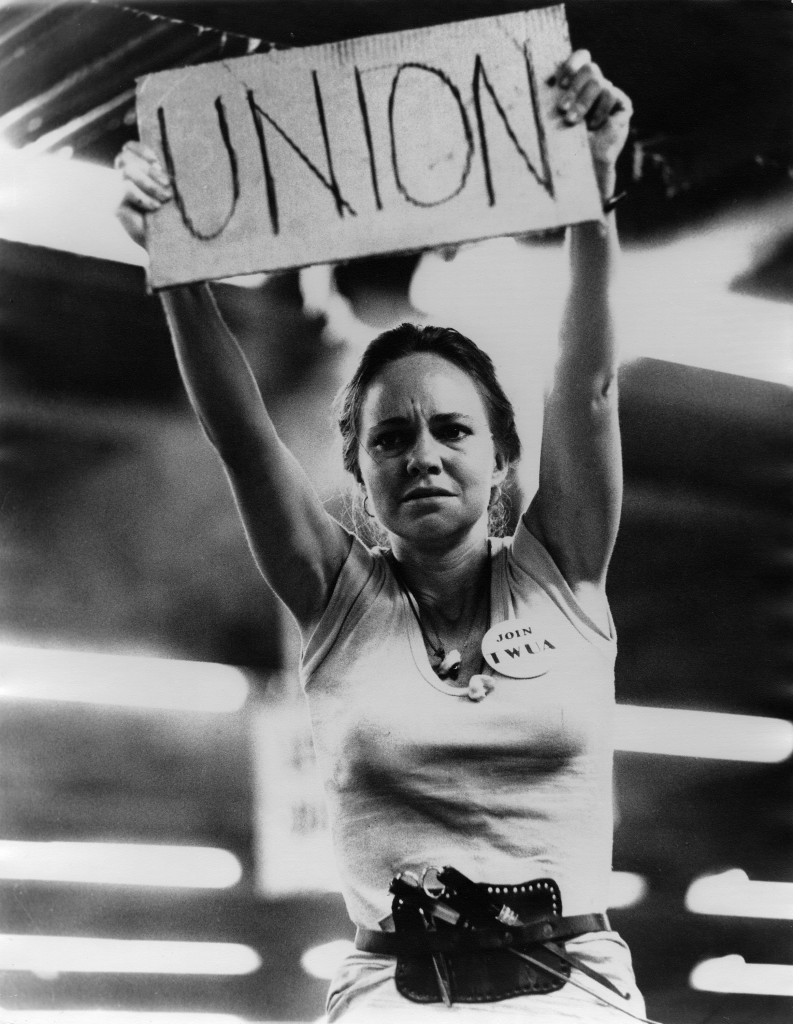
Just recently my union, Actor’s Equity Association (I know, I know what is a stage manager doing in an actor’s union) went on strike against the Broadway League’s use of various developmental projects spurred on by a thirteen year unattended agreement called the LAB agreement. Yes, for thirteen years theatre producers have been using this agreement to develop book, music, choreography & concept. These LAB’s have sometimes grown to be very elaborate, like a six pack and a shove from a full production. From one point of view a producer might say they need to see all of these elements to make sure they are on the right track before they spend 16-20 million dollars to mount a Broadway Musical, I mean that’s a lot of money. Investors and theatre owners may not have the director’s wonderful sense of vision so the producer sort of puts “LAB-vision-glasses” on their faces, fair story! But I return to the “unattended” part, which is the provisions for the AEA members involved in these projects. For thirteen years the union & the League have not re-negotiated the pay or conditions for these LABS and over those thirteen years the membership has grown resentful.
I am a parent, so I tend to look at situations through a parental lens, so keep that in mind as I try to explain. If my son, who is fourteen, had been sent out to live his life and his parameters never changed from the ones I had originally assigned he would grow out of control and follow whoever was willing to pay him attention. So, AEA says we are going to create this LAB contract so all of our dancers who are dancing pre-production for choreographers with no benefits and goodness only knows what kind of money get proper compensation. They loosely outline what these are to be, because remember when it was set up it was to protect a few marginalized performers. In come Producers who say, heck, if we are going to have to pay weekly salaries and benefits to performers and stage managers let’s use the time and money to our advantage. As the shows grew in scale and scope so did the demands on the LAB. Now there are still some LABS that are smaller scale, but the strike is focusing on the big guns. I repeat, as the shows grew in scale and scope so did the demands of the LAB… the producers were demanding more and the LAB contract actually allowed for it. So, like my son the LABS grew to be giant and the AEA membership started demanding of the union. After all, how does a contract go unattended for 13 years? How does our union not bring this up over a 13-year period? Surprise, membership is pissed off. So, 13 years later AEA rolls up their sleeves and after town halls and e-mail blasts to determine what the membership feels is important. The ask to the Broadway League does not go well, an insulting reply to the Unions demands and a lack of willingness to negotiate sets the ball rolling and AEA determines the only solution is a work action, a strike.
So, I am sitting here today not being paid at all while I remain in solidarity with my Union. I cannot help but wonder if this garden had been tended to all along would I be preparing to create a piece of theatre instead of wondering if I can pay my bills.
He knew us all as individuals when we ourselves struggled
to be a who, that had a why and sought a path to our where.
We were microscopic balls of id and ego
fighting for our place in and out of the spotlight
the spotlight he shone for us full of pink & blue.
He snatched us from our heroic young roles across the country
and had us feed together from the belly of comedy and tragedy.
The mission, a place in the pantheon of theatrical greatness
or maybe a chance to find our way without the rigor of a mold.
We were to be our own person, finding our who, what, where, when, yes and, why.
His direction, the slightest touch at the helm,
should not have made a difference in this great sea before us but it did.
Such a subtle shift in our art that you had no idea what was happening
never a lecture took place, not a lesson on a page, nor a chapter in a book.
He attached us to our greatness, knowing our weakness
but never letting us weaken ourselves.
We said we knew it all, that our situation was different, yes but,
every story was a repeat musical phrase to his ears.
Yet, he never dismissed us, he listened and watched us work it out.
He poked the bear of curiosity and made us find our own truth
be our own professor to build our own lectern.
Grow and not turn back…
One person is missing and I’m turned upside down
I can no longer connect the dots, my dots are missing
they are now millions of stars that fade in and out, too fast to identify.
One who I could rely on is missing from my greater landscape,
it’s now a fallow field missing the nutrients of my history and my present.
He was snatched away leaving our hearts struggling.
We thousands have no claim, do we?
He was a man who staked a claim,
yet he made no claim to our greatness.
His greatness was in the great amount of joy
he found as we all satisfied our curiosity.
A curiosity he understood long before we examined it.
Peter Sargent was a man who helped define me as a theatrical professional. He continued to be the man that I wanted to make proud. I wanted to give back to him, with my career, what he gave to me as a constant in my professional journey. He is gone now, unbelievably taken by death so quickly it still seems unreal. I feel the loss more every day, there are no texts or e-mails or phone calls. No sitting side by side during Webster’s yearly pilgrimage to NYC where he deftly tells me about most of the seniors no matter their discipline. No more annual dinners where I could laugh with him, share my life with him on and off stage. I suppose if I were more evolved I could continue to make his “memory” proud as I continue my career, but honestly, I selfishly want to make him proud in person. He is not a memory to me, he is a man alive and well who help shaped me into who I am today and I miss him dearly.
They are a master negotiator
with their columns of nothing
that ignite joy when met
the object of desire.
Their art might
in the corner, not distracting
but engaging our imagination
while sculpting our players.
They manage expectation.
Laying a base of clarity
then a splash – a pop – a sizzle
but only when the time is right.
They help us to experience
Intimacy… fear… hope…
We are guided around the stage by their craft
and only released from their power at the final bow.
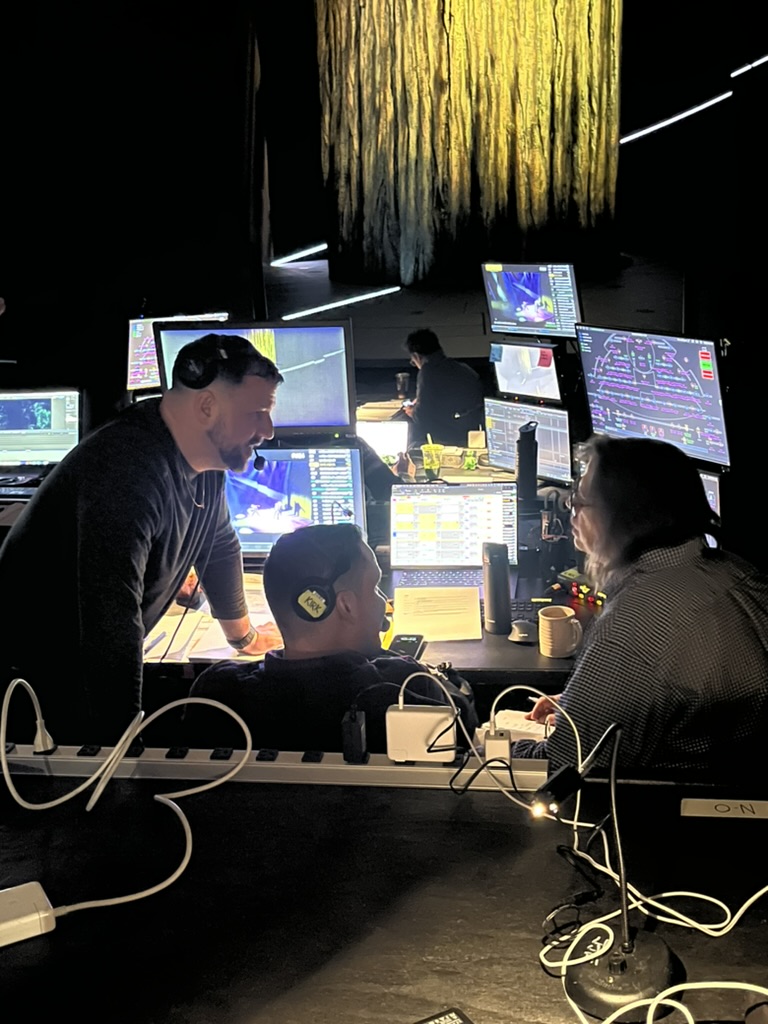
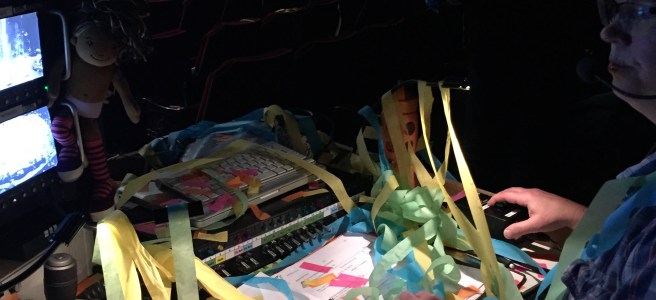
I am a design freak. I love visual artists and especially ones that can make their art into a practical world that a show can live in or wear. That said there are two disciplines of design that seem like magic to me because you cannot paint or build them; Lighting Design and Sound Design. These are artists that create a world in their minds eye (or ear) and can only execute it live. We as stage managers have an interesting responsibility to Lighting Designers. They in a way entrust their art to us. Not the mechanical side, although it’s always helpful if you understand the nuts and bolts. Our part of this art is the calling of cues, the “go-go-go” of our daily life on a running show. But before we can start calling those cues we need to know where the cues are to be called.
Oh, the tech process… I can’t tell you how many helpful lighting designer associates have given me cues to call on “A” letter of a word. That’s it, no courtship no recognizing me as a lighting ally just, “call it here” monkey. My co-workers and I will often joke about calling a cue on the “K” of knife or the “P” of psoriasis. There isn’t a silent letter that stands in our way. So I due diligence calling on the letter, anticipating the letter, all the tricks to make that “Go” sail into the head set and land gloriously onstage as a light cue that changes the landscape on the stage in historic fashion, 600 times a night. I gather my notes making adjustments with a breath here or there, relying on the consistency of my pal on the other end of the headset. Then, a month or so into the run, I can get my head up out of the book and I start to see what is happening onstage. There are inevitably cues that after doing extensive research, because I am not seeing the results of my labor, I find were marker cues and did absolutely nothing onstage or I’m told have ridiculously long fade times never to be detected by the human eye (I can nail those calls) or my favorite discovery is a light cue that was given to me on a word based on blocking that the actor always does and the blocking adjusts but my word never does so it turns out it’s in the wrong place entirely.
Then comes that glorious day you work with a lighting designer who uses you as their creative partner. They either tell you what the cue is for and more or less rely on you to place the cue or they give you where they would like you to call it but give you the basic anatomy of the call; “it wants to warm up stage left by the time the actor arrives” or “I want to hit those little pops in the music”, perhaps you are told we want to see the light move with the scenery. This allows you to not only invest in the success of the cue but it also allows you to make adjustments as the living breathing thing called a play changes with director notes, cast changes, tempo changes… But we as stage managers have to be ready to be that creative partner and take an interest in what a cue is doing. We need to engage during the tech and see when the director approaches the lighting designer or vis-versa because that meeting, although wordless to you in the moment, will often change the art. Take in the entire room, try not to get lost in the games the cast are engaging in onstage to pass the time or the e-mail that pops up on your various devices.
We as Stage Managers are not naturally disposed to being artists we are typically held to communication and support; we must choose to be artist in the theatrical kingdom. One of these outlets is how we call the show, so embrace this art form and make each click of a cue light and each “go” of a light cue sing into the headset knowing that for that instant you are a part of creating art.
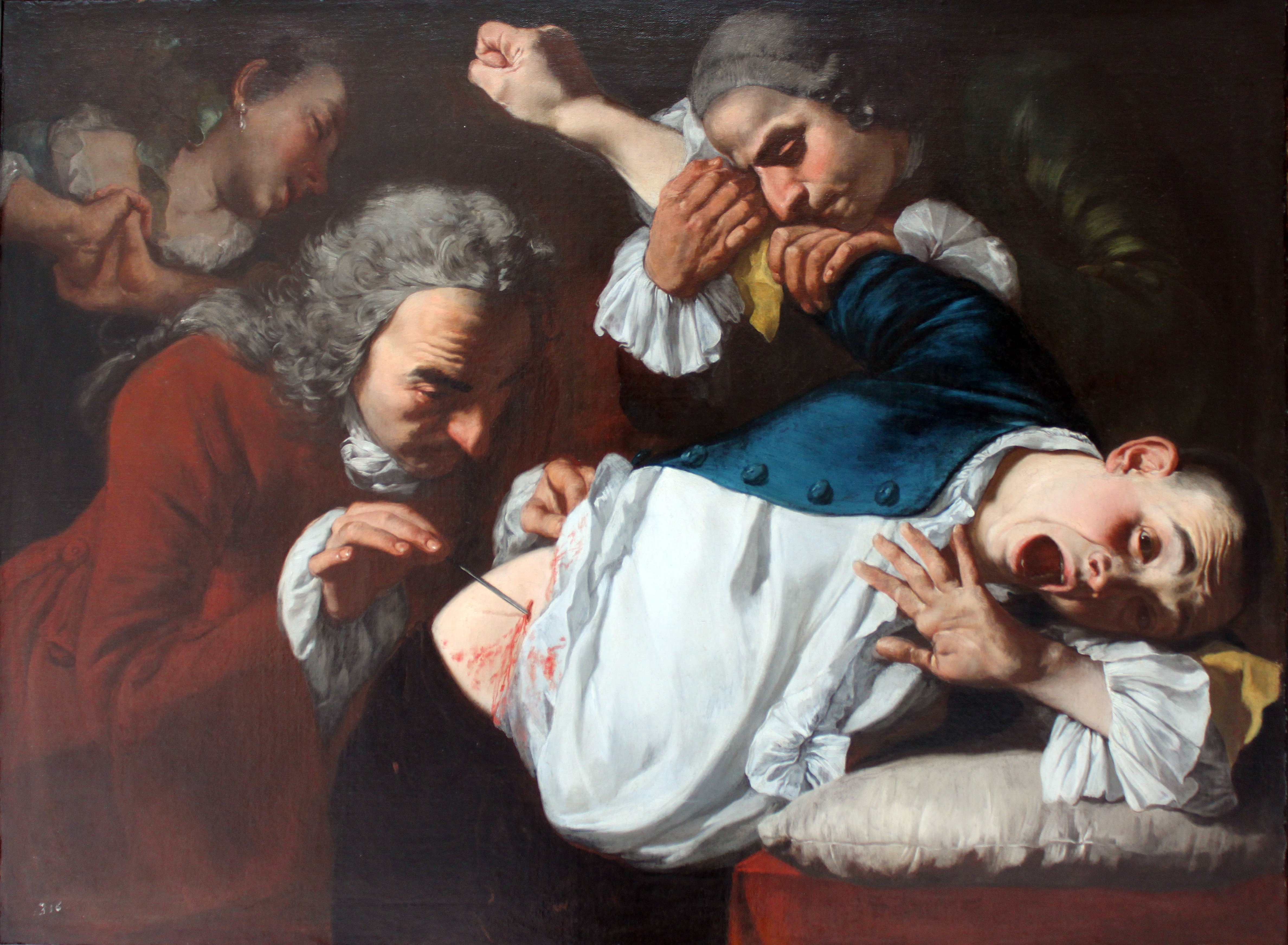 “Its not brain surgery” this is an anthem often heard in the theatre, but I’d like to argue that there is a quality of caring among professionals in the theatre that makes this work our brain surgery. Lets face it, most of we theatre professionals never wanted to be brain surgeons nor did we likely have the passion for biology to consider this life or death profession. So while I am not going to trust the inimitable Jack O’Brien to wield a scalpel near any of my vital organs, I am going to trust that this master of the boards will make every attempt to see that a play is directed with absolute precision and heart. I believe the exchange for science is emotion and the delicate hand it takes to navigate around the emotional beings of the theatre takes absolute concentration and skill. When I go to work I am managing complex groups of people not governed by a code of ethics or trained for a very specific task repeated multiple times daily. These are people who invest in a living breathing entity called theatre. So to the dilemma I find myself facing; How do we as Stage Managers not let our devotion take us on every rollercoaster ride we are presented with in the theatre? How do we put breaks on our give-a-shitter?



 The Tao of Stage Managing