Goodnight Sweet Peter and flights of angels sing thee to thy rest

He knew us all as individuals when we ourselves struggled
to be a who, that had a why and sought a path to our where.
We were microscopic balls of id and ego
fighting for our place in and out of the spotlight
the spotlight he shone for us full of pink & blue.
He snatched us from our heroic young roles across the country
and had us feed together from the belly of comedy and tragedy.
The mission, a place in the pantheon of theatrical greatness
or maybe a chance to find our way without the rigor of a mold.
We were to be our own person, finding our who, what, where, when, yes and, why.

His direction, the slightest touch at the helm,
should not have made a difference in this great sea before us but it did.
Such a subtle shift in our art that you had no idea what was happening
never a lecture took place, not a lesson on a page, nor a chapter in a book.
He attached us to our greatness, knowing our weakness
but never letting us weaken ourselves.
We said we knew it all, that our situation was different, yes but,
every story was a repeat musical phrase to his ears.
Yet, he never dismissed us, he listened and watched us work it out.
He poked the bear of curiosity and made us find our own truth
be our own professor to build our own lectern.
Grow and not turn back…

One person is missing and I’m turned upside down
I can no longer connect the dots, my dots are missing
they are now millions of stars that fade in and out, too fast to identify.
One who I could rely on is missing from my greater landscape,
it’s now a fallow field missing the nutrients of my history and my present.

He was snatched away leaving our hearts struggling.
We thousands have no claim, do we?
He was a man who staked a claim,
yet he made no claim to our greatness.
His greatness was in the great amount of joy
he found as we all satisfied our curiosity.
A curiosity he understood long before we examined it.

Peter Sargent was a man who helped define me as a theatrical professional. He continued to be the man that I wanted to make proud. I wanted to give back to him, with my career, what he gave to me as a constant in my professional journey. He is gone now, unbelievably taken by death so quickly it still seems unreal.  I feel the loss more every day, there are no texts or e-mails or phone calls. No sitting side by side during Webster’s yearly pilgrimage to NYC where he deftly tells me about most of the seniors no matter their discipline. No more annual dinners where I could laugh with him, share my life with him on and off stage. I suppose if I were more evolved I could continue to make his “memory” proud as I continue my career, but honestly, I selfishly want to make him proud in person. He is not a memory to me, he is a man alive and well who help shaped me into who I am today and I miss him dearly.

http://news.webster.edu/employee/2019/peter_sargent_remembered.html
 

Call it on the P of psoriasis: the journey of a lighting cue

They are a master negotiator
with their columns of nothing
that ignite joy when met
the object of desire.

Their art might
in the corner, not distracting
but engaging our imagination
while sculpting our players.

They manage expectation.
Laying a base of clarity
then a splash – a pop – a sizzle
but only when the time is right.

They help us to experience
Intimacy… fear… hope…
We are guided around the stage by their craft
and only released from their power at the final bow.


I am a design freak. I love visual artists and especially ones that can make their art into a practical world that a show can live in or wear. That said there are two disciplines of design that seem like magic to me because you cannot paint or build them; Lighting Design and Sound Design. These are artists that create a world in their minds eye (or ear) and can only execute it live. We as stage managers have an interesting responsibility to Lighting Designers. They in a way entrust their art to us. Not the mechanical side, although it’s always helpful if you understand the nuts and bolts. Our part of this art is the calling of cues, the “go-go-go” of our daily life on a running show. But before we can start calling those cues we need to know where the cues are to be called.

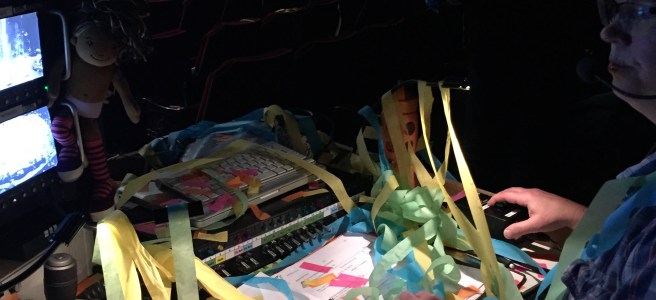
Oh, the tech process… I can’t tell you how many helpful lighting designer associates have given me cues to call on “A” letter of a word. That’s it, no courtship no recognizing me as a lighting ally just, “call it here” monkey.  My co-workers and I will often joke about calling a cue on the “K” of knife or the “P” of psoriasis. There isn’t a silent letter that stands in our way. So I due diligence calling on the letter, anticipating the letter, all the tricks to make that “Go” sail into the head set and land gloriously onstage as a light cue that changes the landscape on the stage in historic fashion, 600 times a night. I gather my notes making adjustments with a breath here or there, relying on the consistency of my pal on the other end of the headset. Then, a month or so into the run, I can get my head up out of the book and I start to see what is happening onstage. There are inevitably cues that after doing extensive research,  because I am not seeing the results of my labor, I find were marker cues and did absolutely nothing onstage or I’m told have ridiculously long fade times never to be detected by the human eye (I can nail those calls) or my favorite discovery is a light cue that was given to me on a word based on blocking that the actor always does and the blocking adjusts but my word never does so it turns out it’s in the wrong place entirely.

Then comes that glorious day you work with a lighting designer who uses you as their creative partner. They either tell you what the cue is for and more or less rely on you to place the cue or they give you where they would like you to call it but give you the basic anatomy of the call; “it wants to warm up stage left by the time the actor arrives” or “I want to hit those little pops in the music”, perhaps you are told we want to see the light move with the scenery. This allows you to not only invest in the success of the cue but it also allows you to make adjustments as the living breathing thing called a play changes with director notes, cast changes, tempo changes… But we as stage managers have to be ready to be that creative partner and take an interest in what a cue is doing. We need to engage during the tech and see when the director approaches the lighting designer or vis-versa because that meeting, although wordless to you in the moment, will often change the art. Take in the entire room, try not to get lost in the games the cast are engaging in onstage to pass the time or the e-mail that pops up on your various devices.

We as Stage Managers are not naturally disposed to being artists we are typically held to communication and support; we must choose to be artist in the theatrical kingdom. One of these outlets is how we call the show, so embrace this art form and make each click of a cue light and each “go” of a light cue sing into the headset knowing that for that instant you are a part of creating art.