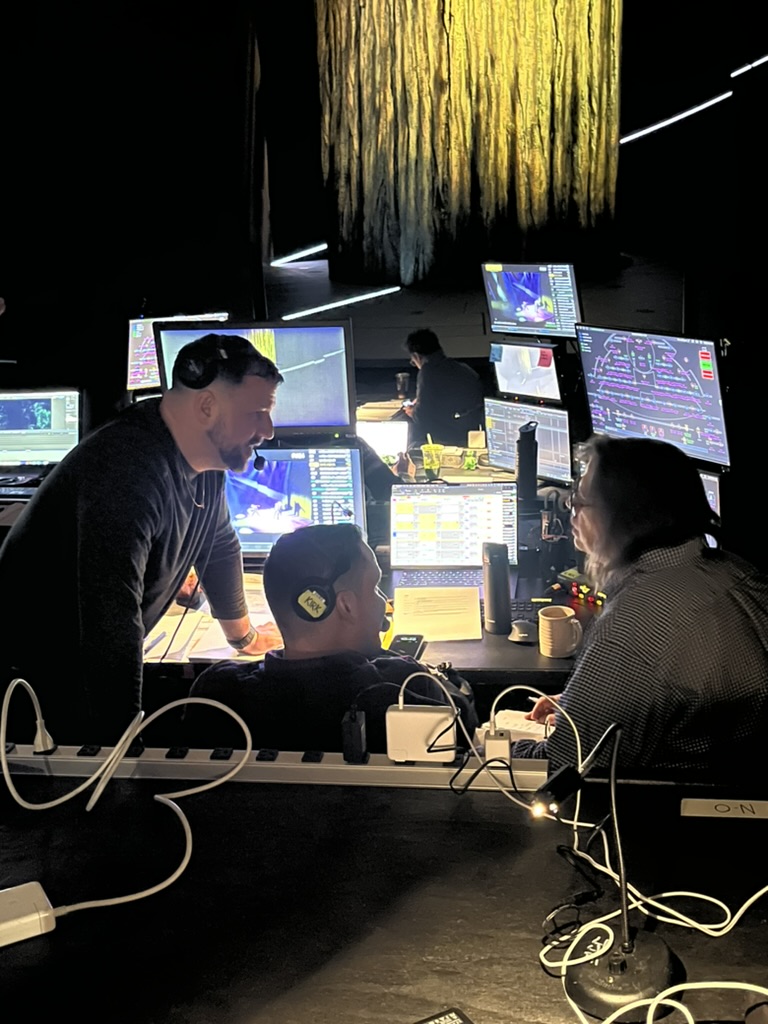
Life in a Work of Theatre

The rainbow slides and lemon aid falls
of work-life balance in the theatre
we strive for a life in the theatre
not a work in the theatre
though there are works of theatre
but I have made my life in the theatre
I share not my work with my life
I have work in my life
no wait, I have a life in my work
so inextricably linked a vocation
a rainbow slide into
my life’s work
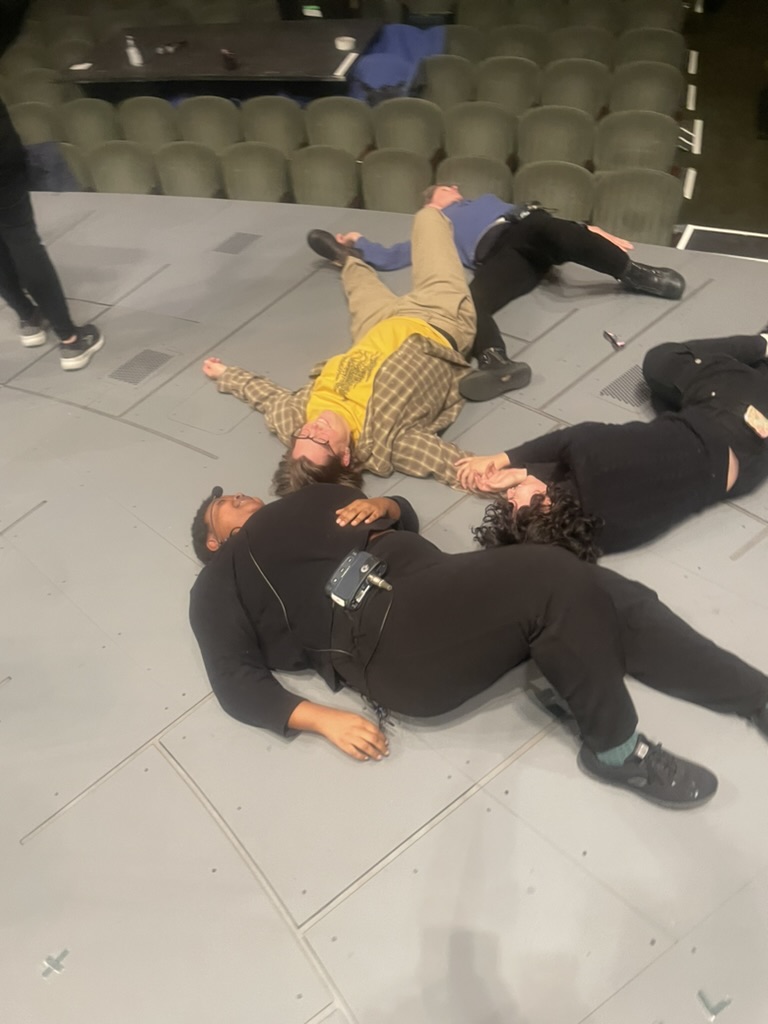
It’s all going well I think

Everyone has the right to debate this statement, and this will certainly require a little framing, but I do not believe in “work life” balance. I do “work” in the theatre, but it is also a part of my DNA, a life in the theatre. The world is a crazy mixed-up quilt. Nobody promised me Monday – Friday with weekends and holidays paid. In fact, I have gone out of my way to work hard to become who I have become. A theatre professional. My family is not my “work”, they are another part of my beautiful life. My animals, my home, my hobbies are all parts of my life, just as the theatre is a part of my life. I find balance in these different areas of my life by connecting fully to only them in the moment. I work toward not to think about a show’s task or a work conflict when I am with my family (admittedly mobile phones have made this challenging). There is a Buddhist tenet that requires you to focus on the present moment, “when you polish the stone, polish the stone” (brought to my attention by a friend who was introduced to this concept by his brother-in-law who was a monk). I try to not let my life in the theatre cloud the other aspects of my life but rather enhance them.  If you can’t be with the one you love, love the one you’re with … maybe the Buddhist say it better than Stephen Stills …

As a stage manager we clock more hours in the rooms because our job relies on communicating with all the disciplines to stay in step, or dare say, stay ahead of the curve. I admittedly struggle with the being “ahead”, so I tend to spend a ridiculous number of hours present & listening. I envy those stage managers with their facile minds that can arrive with a clear plan right before the actors or director arrives. However, you work to achieve your excellence, try to remember shows are temporary (for most of us that have not found themselves or desire to be on a multi-year veteran of a mega hit). Each show must be welcomed into your life and cherished while you discover all the newness of each relationship.

While no individual should ever feel exploited or abused by a schedule, try to remember that you are building a living piece of art and it takes time and that creation time is compressed for a variety of reasons.
I know things now

When you receive a book do you take in the cover front and back? Perhaps you open the cover and scan the informational pages? Chances are you do not turn to chapter one and dig right in with no context.

Okay, quick reset, maybe you are not a book reader, but that doesn’t mean you can’t enjoy the world of stories and imagination. There are countless ways to engage with narratives that don’t require you to pick up a traditional book. Whether it’s through audiobooks, podcasts, or even films and TV series, you can dive into captivating plots and delightful characters. In fact, many people find that visual storytelling through cinema or engaging discussions on topics via podcasts can offer a similar thrill and depth that reading does, making it accessible for everyone, including those who may not be inclined to read.

When we launch into a new show as Stage Managers, you likely have a comprehensive check list:

Supplies to buy

   Script work to do

      Rehearsal hall set up

         Ground plans & scene shifts

             Costume plots …

                     Contact: Director, Designers, cast …

Lists, oh so many fuckin’ lists. I know, I have these lists too. These are the tools every Stage Manager needs to have to make a new production happen. Answering all these lists make us feel like we are going to be able to guide the show successfully into the future production period. As things arrive on our desks, there is a pretty good chance we have the answer on some list or at least the most effective route to find answers.

Now I want to take you on a different journey a journey Oscar Hammerstein called, “getting to know you, getting to know all about you.” You don’t have to start at the top, but I find, “it’s a very good place to start.” Geez, is there nothing this guy didn’t write?

I like to know the heartbeat of the people in the room and the people who create the room. No social media please, that is a façade that will lead you off track. 

Who is the producer? Not the many dedicated people who want to be involved in a new production, who is the individual calling the shots? How does their career tell a story?

A career tells a story, but all the pages must be read.

There are details in the margins and clues at every bend

Are they waking senses or gaining cents off woke?

No judgement should we make, but reality must be known.

Is there history being written in union halls & books?

They are not going to tell you, these facts you’ll need to cull.

Are directors being supported or supporting the design?

“I’m just a girl who can’t say no” … but I know who I am saying yes to.

The managers. The heavy weights. Those General Managers & Company Managers who hold up the mantel for the producer. God bless them and keep them for theirs is an art in keeping everything on track with creativity, diplomacy & a keen eye for the art of it all. 

The constant push pull engines, the fact gatherers 

What is word on the street, in the halls, among your peers?

Are they the group that celebrates the bottom line first?

Are they sitting on a hit with their first-string players so your show will see the B team?

Do they work directly for the producer so there may be a fuzzy line?

Does your company manager work for them all the time?

Are they “old school” … or have they taken a new path.

The creative Team. The heart of the production as lead by the director. Oh, Captain, My Captain. Each other creative is guided by this individual, weather it is a musical and they are in complete cahoots with the music supervisor & the choreographer, or a play and they are more autonomous.  

Is direction an edict or 

a path that souls follow to creation?

Is the process handed to you in a playbook or

is it locked away in a beautiful mind that you need to ally? 

Are you being hired because your plan is in place or

are you holding up and supporting a plan that finds it’s way magically?

Is all of your organization and work for your benefit or

is it necessary for them to feel free knowing it’s in place?

Once you know these leaders the fabric of the show will unfold.  The journey of discovery does not end there. As you get to know the cast, scratch below the surface and start noticing what brings joy and allows them to feel safe so each person can soar. 

Spend as much time as you can getting to know each person on the crew, you will find no end to the stories that come with a life in the theatre. Show respect to the theatre staff who have seen everything that happens in the building. 

A victorious life in the theatre is to know the people you are creating art with and to be with them in harmony.

Call it on the P of psoriasis: the journey of a lighting cue

They are a master negotiator
with their columns of nothing
that ignite joy when met
the object of desire.

Their art might
in the corner, not distracting
but engaging our imagination
while sculpting our players.

They manage expectation.
Laying a base of clarity
then a splash – a pop – a sizzle
but only when the time is right.

They help us to experience
Intimacy… fear… hope…
We are guided around the stage by their craft
and only released from their power at the final bow.


I am a design freak. I love visual artists and especially ones that can make their art into a practical world that a show can live in or wear. That said there are two disciplines of design that seem like magic to me because you cannot paint or build them; Lighting Design and Sound Design. These are artists that create a world in their minds eye (or ear) and can only execute it live. We as stage managers have an interesting responsibility to Lighting Designers. They in a way entrust their art to us. Not the mechanical side, although it’s always helpful if you understand the nuts and bolts. Our part of this art is the calling of cues, the “go-go-go” of our daily life on a running show. But before we can start calling those cues we need to know where the cues are to be called.

Oh, the tech process… I can’t tell you how many helpful lighting designer associates have given me cues to call on “A” letter of a word. That’s it, no courtship no recognizing me as a lighting ally just, “call it here” monkey.  My co-workers and I will often joke about calling a cue on the “K” of knife or the “P” of psoriasis. There isn’t a silent letter that stands in our way. So I due diligence calling on the letter, anticipating the letter, all the tricks to make that “Go” sail into the head set and land gloriously onstage as a light cue that changes the landscape on the stage in historic fashion, 600 times a night. I gather my notes making adjustments with a breath here or there, relying on the consistency of my pal on the other end of the headset. Then, a month or so into the run, I can get my head up out of the book and I start to see what is happening onstage. There are inevitably cues that after doing extensive research,  because I am not seeing the results of my labor, I find were marker cues and did absolutely nothing onstage or I’m told have ridiculously long fade times never to be detected by the human eye (I can nail those calls) or my favorite discovery is a light cue that was given to me on a word based on blocking that the actor always does and the blocking adjusts but my word never does so it turns out it’s in the wrong place entirely.

Then comes that glorious day you work with a lighting designer who uses you as their creative partner. They either tell you what the cue is for and more or less rely on you to place the cue or they give you where they would like you to call it but give you the basic anatomy of the call; “it wants to warm up stage left by the time the actor arrives” or “I want to hit those little pops in the music”, perhaps you are told we want to see the light move with the scenery. This allows you to not only invest in the success of the cue but it also allows you to make adjustments as the living breathing thing called a play changes with director notes, cast changes, tempo changes… But we as stage managers have to be ready to be that creative partner and take an interest in what a cue is doing. We need to engage during the tech and see when the director approaches the lighting designer or vis-versa because that meeting, although wordless to you in the moment, will often change the art. Take in the entire room, try not to get lost in the games the cast are engaging in onstage to pass the time or the e-mail that pops up on your various devices.

We as Stage Managers are not naturally disposed to being artists we are typically held to communication and support; we must choose to be artist in the theatrical kingdom. One of these outlets is how we call the show, so embrace this art form and make each click of a cue light and each “go” of a light cue sing into the headset knowing that for that instant you are a part of creating art.

A Few Thoughts for Young Stage Managers

What would happen if we put down the screens in rehearsal
If our young stage managers were able to absorb “the room”
soak up its magic… energy… urgency?

Try, the masters of our future, to let your
imagination dance among the interest of others
as they live and as they reveal.
Take a step back from building and bettering.

What would happen if the line weren’t always perfect
if the column didn’t add up but you knew the why of it?
What if Instead of dotting the “i” you watched a flower grow?

What would happen if you let go of perfection
and let respect guide your decisions?
What would happen if the power went dim
and only your light was available to hold the room?

I am inspired to write this blog not as a chastisement to our future stage managers and certainly not as an affront to all of my friends and colleagues grooming these very efficient managers in Universities across the country. I am writing it as a reminder to young stage managers that our business allows us to be a unique part of a creative process through the support of actors, directors, designers and a production team. In this age of technology: computers, instant communication, instant information and beautiful paperwork so many young stage managers have become machines and don’t recognize that they are a part of a magical journey.  Don’t get me wrong, I love good paperwork and when I have a choice I love working with a certain Stage Manager who does some of the best paperwork I’ve ever seen. My question to these flashlight clad knights of the future is beyond the paperwork do you know how to communicate with a stage hand with as much respect for their knowledge as you do with  a director or an actor? Do you take the time to understand why the same step, song or moment is worked and re-worked beyond comprehension? Are you okay with being seen and seeing everything and not being involved with the decision, but still willing to understand and uphold that decision? Ours is a curious part of the artistic process but no less a part and if you burrow behind your smart this and i-that you miss so much of what is happening. Lift your eyes and see how an actor digests information, how the story is being told, how the blocking evolves. See what a designer sees so you can maintain their vision, see how a prop is being used so you can make sure the right item is manufactured, see how a costume, that is yet to be worn, could change what is being asked of the person wearing it. I promise you this information will change how you write that report, how you communicate that need, how you enjoy your day.

Please note: I am authoring this blog as a working Stage Manager for the past 27 years and while I work in a commercial theatre setting now and so much of what I do day-to-day is completely mechanical I do try to practice these principles whenever possible. I am  using as my inspiration young stage managers that I have worked with over the last ten years or so, many of which have wildly successful careers, so I am not trying to be an arbiter for what will bring you success. I am suggesting that as you start working in this business don’t forget that it is an ART and you are an artists.

Beauty in a bunch of different people doing one thing together.

(photo “acquired” from the internet and taken by the amazing Joan Marcus)

The following writing, poem for lack of a better word, is inspired by the Company (by company I mean Creatives, Cast, Crew, Producers, Musicians, Managers) of The SpongeBob Musical headed up by Tina Landau and her Viewpoints!

June 19, 2016

An Opening thought for The Best Day Ever…

We have been guided to shape a world with seemingly no rules
so full of joy and colors that it could make a rainbow blush.
We are made stronger by a group gesture of kindness
when the world has delivered pain that has broken through our make-believe.
Our environment is the architecture of mad genius
its slopes and angles offering a comfort that we call home.
There is a spatial relationship between new friends that we quickly call family
this family is there to support us at our most vulnerable moments.
We move at a tempo set for us by the moment we are in
then in the speed of light we are delivered to the moment we live in now.
We remain uncertain of the duration of this beauty we create
but strive to continue with strength and conviction to bring happiness.
All of our senses are alive in a kinesthetic response with the audience
living in the energy that only human response can bring to our art.
Our foundation is built on repetition of action
but within that repetition blows the nuance that leads to change.
Using our soft focus we take in this magical journey with all of its twists and turns
landing in this time, that we’ve come to today, which we all embrace
As. Something. Special.

My viewpoints have been wrapped in a whirl of joy surrounded by beautiful spirits
The familiar who is always ready with a quip full of heart
The one who tries anything and everything beyond comprehension
The professional who wraps us all up into being better
The little engine who could and has done and done and done
The trodder who brings a base of history with their every move
The youth who are still growing into their very talented paws
The creative who have a light in their eyes that cannot be extinguished
The steadfast that offer a calm in the creative storm

I learn and I learn and I learn and I learn and I learn and I learn
you all make me better and for that I remain forever grateful.

Millennials of Management

Ambition is a crafty enemy that can leave who you truly are behind.
Creating a craft doesn’t align with her values, she wants results.
Time to grow is lost in her web of beliefs with their twisted urgency.
Why take the train across the country, by the time you arrive I will be done

You can’t catch me, I’m the gingerbread man

I often write about Stage Managing from the point of view I know best, which not surprisingly is my own. A stage manager of a certain age who has been raised in a variety of theatrical environments. I would like to take a departure from the familiar and try to see life from a very different point of view, the point of view of a generation that is “the new frontier”, the Millennials of management. A talented group of driven managers who definitely threaten we heirs to the throne. With there facile minds and often tone bodies the “say no to drugs” generation is taking broadway by storm.  They are brought to broadway direct from Stage Management programs everywhere. These lads and lassies have some pretty powerful traits; they are young, bright and super ambitious.

“Here I am, ready to go. Last year I was the teacher’s pet and my teacher knows this person who can get me in with a person who I think will put me in touch with this other person they met having drinks with another friend of hers and now I have an interview to be a PA for a new Broadway Musical. Here I am working with this broadway stage manager wowing him with my hard work and powers of excel. This is amazing and the director totally values my contributions & the choreographer said I was “the best”. Here I am in tech, the PA on headset. I have done so much paperwork on this show the ASM’s “couldn’t have done it without me.” To the cast I am part of the team, they told me so at drinks the other night. Previews & Opening Night of my show. There I am in the program, my show. I was so good as the PA, “my PSM” recommended me for another PA job… I start in two weeks, just enough time to fly home and see my folks. Day one of rehearsal for my new Broadway show. The other PA has done some Off Broadway & Regional work but this is her first Broadway show… I guess I’m the voice of experience and I am the script PA so the Bookwriter has been coming directly to me. I’m actually “invaluable to this process.” The other PA’s can run for lunch because I have to be in the scene work rehearsal with the PSM and the director. To the writers I am a part of the team. Previews & Openiong NIght, my show. Two broadway shows on my resume and I have been trained as a sub. Another PA interview in two weeks, just enough time to go to Fire Island with some of the folks from my last show and do the Broadway Cares benefit in the Pines, 1K likes on my last Instagram post, yes. While I was on Fire Island I found out that this new show may be adding an ASM and I am the only one of the PA’s with… broadway experience…

Are we doing a disservice to these powerhouse individuals by promoting their youth and myoptic experience? Or is this actually the future of our business on Broadway? They have cut their teeth on the grizzle of Broadway politics. They are not intimidated by Producers, General Managers & many are friendly with directors & choreographers since they are not bound by the convention of showing deference. It’s a new generation of folks who are proud members of Actor’s Equity Association, they completely missed the generation of stage managers who thought we should be part of the IATSE. Maybe this pride and vibrato is a thing that should be embraced. They are paying their dues as Production Assistants, maybe they don’t need to know how it works in Summer Stock or Tour, Regionally or Off Broadway. I remain true to my upbringing in the business as it has shaped me into the manager and human I am at work, but I will try to keep this new generations legitimacy in mind while I am interviewing to assist them in the future.

taking stress off your “to do” list!


We, as stage managers, absorb a lot of different energy throughout a rehearsal day. Sometimes it is super fantastic creative moments that you almost can’t believe that you get to be a part of. I mean come on, even the most buttoned up among us has to admit when you see true talent and craftsmanship at work it makes you want to put down your Dixon Ticonderoga and let all your senses soak that shit in! Other times, its business as usual, hours spent on details that may or may not  come across in the final product. Then there are the times the room is a pressure filled environment where creative people are taxed and they generously share that tension with you or better take it out on you. Here’s the best part, if you are super lucky you get another group of artists, the design team, that are not in the rehearsal room, but equally as stressed coming at you about their needs. Its pretty fantastic shit and no amount of Calgon is going to take you away (please note this is a late 1980’s reference, but I don’t know a new millennial version). You my friend are right in the middle of a creative process midlife crisis and it is real! A show goes from infancy, childhood, puberty & wild youth before we are really a part of the process.  By the time we are deeply involved you typically have a mature piece of theatre going through a divorce, working out, loosing weight and buying a Maserati convertible. Its about high stakes time, money and public attention.

“By letting go it all gets done.” — Lao Tzu, Tao Te Ching

This quote by Lao Tzu couldn’t be more wrong, right? We can’t “let it all go”, that’s nuts. We need to take every detail on and manage it. That’s our job, we manage the stage and the stage is created by these often emotional minds coming together? I’m not too sure Mr Tzu is so wrong. I don’t think he is saying throw your hands up and quit. I believe we as Stage Managers have to let all that negative energy go. Strip away all the side eye and exasperation and do the task on hand. Imagine if you didn’t contribute to the tension at all. If you could actually let it go and focus on what needs to be done. This is not an easy ask! We managers are human beings, several of us are artists in our hearts and not “Management” performing our task without humanity. I struggle with this every day, but I find when I really am able to rise above and keep what needs to be done in focus it makes every task more doable and allows things to actually get done. “Letting go” is a practice, a discipline you must work every day. You might do it by writing a list with all the emotion attached and then cross through anything that isn’t a doable task. Make real the things that you need to let go in order to actually let them go. Maybe you need to walk away and breath for a moment and then take a look at the real task. If you are able to master this, bless you, if you are like me you will need to constantly remind yourself but the results are worth it. We can get it all done.